What Is a Chenille Patch? Varsity Letters, Materials and Uses
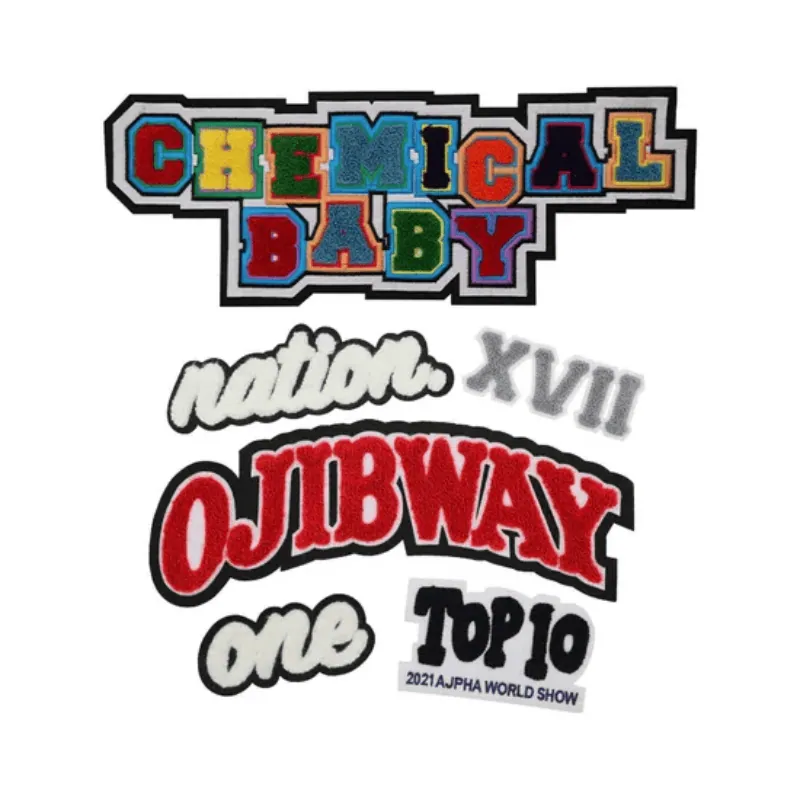
A chenille patch is a badge made from tufted, fuzzy yarn stitched onto a felt or twill base and finished with an embroidered border. You have seen hundreds of them. The fat soft letters on a letterman jacket, the team crest on a club blazer, the school name on a cheer bag: that raised, velvety surface is chenille.
Below is what the yarn actually is, why the pile looks the way it does, how backing and border choices change the product, and how to order custom chenille patches without burning a sample round.
What chenille yarn actually is
Chenille is a yarn, not a weave. Short fibres are held between twisted core threads, and the pile then stands out on every side of the strand, which makes a single length look like a small fuzzy caterpillar (Wikipedia: chenille fabric). The name comes from the French word for caterpillar. That is honest labeling, at least.
Chenille yarn can be made from cotton, silk, wool, rayon or synthetic fibres. For patch work the yarn and the base fabric get chosen together, because the pile has to sit on something stable enough to survive a heat press and a washing machine. In our workshop the fabric base for chenille work is typically polyester, twill, cotton, silk or non-woven, and the pile yarn is colour matched to the Pantone reference on your artwork.
One practical consequence: the yarn carries the colour, not a printed ink layer. Deep shades stay deep. Brights stay bright. What you do not get is photographic gradients or one pixel hairlines.
Why the pile has that raised, soft look
Run a finger across a chenille patch and you feel a dense, even cushion. That comes from pile height, not from stitch density. Thick tufted yarn fills the shape of a letter or a mascot outline completely, so there are no visible gaps between stitches and no flat base showing through. Light hits it from different angles and the surface goes slightly lighter or darker as the patch moves. That is the whole charm.
The trade-off is detail. A chenille letter reads beautifully from across a parking lot. Tiny text inside that letter does not. Anything below roughly a few millimetres of stroke width turns into mush, so most experienced buyers split the design: chenille for the big shapes, machine embroidery for the small copy, the outline and the border. Ask your supplier which elements they would move to thread before you approve artwork. A blunt answer here saves you money later.
Backing, border and construction
Three parts decide how a chenille patch performs: the base fabric, the border, and the backing.
- Base fabric. Felt is the classic choice and gives that dense vintage feel. Twill and cotton are firmer and hold shape on curved garments. Non-woven bases are lighter and cheaper.
- Border. A merrowed (embroidered overlock) edge wraps thread around the entire perimeter and is the traditional look for letters and crests. Laser-cut and heat-cut edges give a cleaner, flatter outline for shaped designs.
- Backing. This is the layer that attaches the patch to the garment, and it is where most ordering mistakes happen.
Our own chenille production covers heat seal (iron-on) backing, plastic backing, non-woven backing, adhesive backing and hook-and-loop backing, so the same artwork can be built for a jacket, a display board or a removable morale patch. You can see the range on our custom chenille patches page, including iron-on letter and logo appliques and seasonal chenille designs.
Varsity letters, school jackets and club use
The varsity letter is an American tradition: a large initial awarded by a school or college for athletic achievement, and in many schools for other activities too, then worn on a jacket or sweater as a visible record of it (Wikipedia: varsity letter). Chenille is what gives that letter its body. Embroidered letters look flatter and more modern; chenille letters look like 1978, in the best way.
Where else do they earn their keep? Club blazers and committee jackets. Scout-style and youth-group badges. Cheer, dance and marching band bags. Staff recognition pieces where a woven label would feel too corporate. Alumni and reunion merch, which is a category that keeps growing because the nostalgia is free.
Say you run a high school athletics department and need 400 single letters across three sports, each with a contrasting border. That is a straightforward chenille job: one artwork file per letter, one Pantone set, one backing choice. Now imagine a cycling club that wants a 90 mm crest with the club name and an est. year inside it. That one needs a mixed construction, chenille body plus embroidered lettering, or the small text will not survive.
Iron-on vs sew-on: what the backing data tells you
Iron-on is faster. Sew-on lasts longer. Everything else is a variation on those two sentences, and the table below is the short version we give buyers.
| Backing | How it attaches | Best for | Watch out for |
|---|---|---|---|
| Heat seal / iron-on | Heat press or household iron | Cotton and twill jackets, bags, flat fabric faces | Poor grip on nylon, coated, stretchy or heavily textured fabric; needs even pressure and heat |
| Sew-on (plain or non-woven backing) | Stitched around the border | Heavy wear, wool and leather, workwear, items washed often | Adds labour time; sewing through a thick border takes a sturdy needle |
| Hook and loop | Removable panel | Tactical gear, event swaps, uniforms with changing insignia | Loop side must be attached to the garment as well |
| Adhesive (peel and stick) | Pressure only | Craft projects, displays, temporary signage | Not a permanent garment fix; will lift with washing |
| Plastic backing | Support layer plus chosen fix | Shaped or stiff patches, retail display | Adds rigidity; ask how it feels on lightweight fabric |
Application temperature and dwell time vary by backing and fabric, so ask your supplier for the numbers that match the batch you receive. Guessing with a hot iron on a synthetic jacket is how patches get ruined.
Chenille vs embroidered vs woven
Three patch types, three jobs. Chenille is about texture and size: big shapes, thick pile, retro feel, limited fine detail. Embroidery stitches thicker thread into a base fabric for a raised, traditional look with better small-detail performance than chenille. Woven patches interlace fine threads with no base fabric at all, so they hold tiny text, fine lines and complex patterns, and they lie flat. If your artwork is a dense logo with a tagline, a woven or embroidered patch will serve you better. We compare them in more depth in woven vs embroidered patches and in chenille patches explained.
Rule of thumb: big letter or mascot shape, choose chenille. Detailed logo or small lettering, choose woven. Classic crest with medium detail, choose embroidery.
Care and washing
Chenille survives real life. Treat it like a wool sweater rather than a T-shirt.
- Wash inside out, cold water, gentle cycle. High heat mats the pile.
- Skip the tumble dryer or use the lowest setting. Air drying keeps the fuzz soft.
- Never press a hot iron directly onto the pile. Iron the garment from the reverse side or use a pressing cloth.
- For workwear, school kit that goes home with students, or anything washed weekly, specify sew-on. Heat seal adhesive is strong, but repeated hot washes are its weak point.
- Store jackets on a hanger rather than folded tight against other patches, which can crush the pile over a season.
How to order custom chenille patches
Good ordering is boring. It is also cheap.
- Artwork. Vector files work best, Adobe Illustrator or CorelDRAW. Colours should be Pantone Solid Coated references, not screen hex codes. Free design support is part of what we do, so a sketch on a napkin can be turned into a production file.
- Decide the split. Mark which parts are chenille and which are embroidery. Confirm border style and base fabric.
- Pick the backing. Iron-on for speed, sew-on for durability, hook and loop for removability. Tell us the garment fabric, not just the patch use.
- Approve a sample. Samples usually take 3 to 8 days. Check pile height, colour against your Pantone reference, border thickness and the sharpness of the lettering.
- Production. Bulk runs typically take 7 to 15 days depending on the item, and large orders are scheduled with your sales contact.
We accept custom work regardless of order size, which matters if you are a club secretary buying 30 pieces rather than a distributor buying 3,000. Payment runs through T/T, L/C or PayPal. Small or urgent shipments go by DHL, FedEx, TNT or UPS; larger orders by air or sea.
Start your chenille patch order
Send the artwork, the quantity and the garment you are attaching to, and you will get a quote and a suggested construction. That is the whole brief.
Reach us at contact us or email order@ty-gifts.com, or call and message +86 181 2281 1289 on WhatsApp. Our sales team is online 24 hours and replies within 8 hours. You can also browse the full custom patches range, including chenille, embroidered, woven and PVC, to see what fits your project.
Frequently asked questions
What is a chenille patch made of?
Tufted chenille yarn stitched onto a base fabric such as felt, twill, cotton or non-woven material, finished with an embroidered or cut border and a backing layer. The yarn provides the fuzzy pile; the base keeps the shape stable.
Can chenille patches be washed?
Yes, with care. Wash inside out in cold water on a gentle cycle, avoid high dryer heat, and never press a hot iron directly onto the pile. If the item is washed often, choose a sew-on backing rather than iron-on.
Are chenille patches only for varsity letters?
No. Letters are the classic use, but the same construction works for mascots, club crests, seasonal designs, brand logos in large shapes and shaped patches with a cut border. Fine detail and small text are better handled by embroidery or a woven patch.
Can I order a small quantity of custom chenille patches?
Yes. We accept custom orders regardless of order size, and design work is free. Samples usually take 3 to 8 days and bulk production typically runs 7 to 15 days depending on the item.