PVC Patches vs Embroidered Patches: Durability, Detail and Cost
Comparing pvc patches vs embroidered patches looks like a style question. It is really a question about process, and that process decides everything else: how much detail you get, how the patch feels under your thumb, how it survives a wash, and what it costs per piece at your order quantity. We mould PVC and we stitch embroidery in our own production, so the notes below come from the bench, not a catalogue. Here is how to pick.
One is moulded. The other is stitched
Soft PVC patches begin as a liquid plastic. Polyvinyl chloride is a thermoplastic made from vinyl chloride monomer (Wikipedia), and for patches it is injected into a machined mould, filled with colour, then set. Our PVC factory runs that line. The mould carries the shape: a flat 2D face, a raised border, or 3D relief where parts of the artwork stand at different heights. Colour goes into cavities, so a seven colour design is seven fills, not seven thread changes.
Buyers often ask for rubber patches when they mean soft PVC. The hand feel is rubbery, the material is PVC, and the process is moulding rather than rubber vulcanising. Same family of product, different name.
Embroidered patches are sewn. A computerised machine stitches thread into a twill, felt or cotton base, one colour at a time (Wikipedia). Quality comes from stitch density, thread choice and the digitising file, not from a mould. Nobody carves tooling. Your logo becomes a stitch program.
That single difference explains the rest of this article.
What each one looks like on a jacket
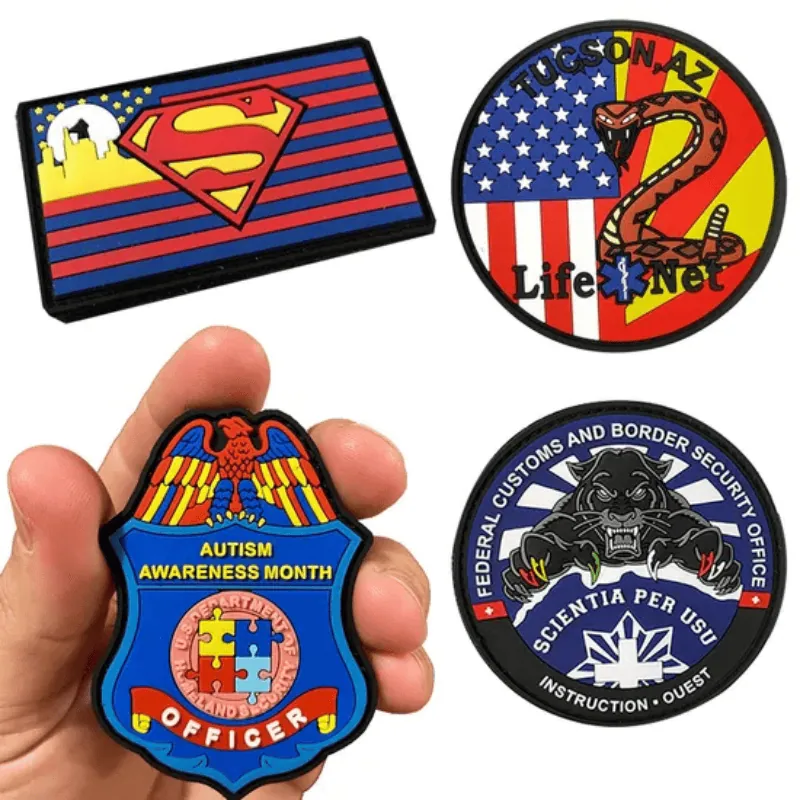
PVC reads modern and graphic. The surface is flat or lightly satin, colours are clean fields with no thread direction, and the die-cut edge follows your outline exactly. If you want a crisp cartoon mascot, a bold geometric logo or a badge with real height in the middle, moulding delivers it. Gradients and multi-colour fills are straightforward because pigment is poured, not stitched. Our 2D and 3D PVC rubber patches show the range of builds.
Embroidery reads heritage. You see and feel thread: slight sheen, tiny ridges, a merrowed or laser-cut border. On a denim jacket or a club blazer it looks like it has always been there. The trade-off is precision. Thin strokes and tiny type get swallowed by the stitch, and a gradient has to be faked with stepped colour blocks. Character over sharpness. Plenty of buyers want exactly that.
Weather, washing and abrasion
Water is where PVC pulls ahead. The material does not absorb moisture, so rain beads off and mud wipes away with a damp cloth. A patch on a work jacket or a hiking pack stays clean-looking with almost no effort. Embroidery holds water in the thread and the base fabric. A soaked patch takes longer to dry, and repeated damp storage is unkind to it.
Washing is similar. PVC handles a normal machine cycle and comes out looking much the same, which matters for uniforms and kit that someone else launders. Embroidered patches survive washing too, but thread dulls, edges can fuzz, and dryer heat is not a friend.
Abrasion is a closer call. Embroidery is thicker and stands proud, so the stitch bundle takes scrapes well, though a sharp snag can pull a loop. PVC resists surface scuffing but a hard knock can chip a fine 3D detail or shear off a thin protrusion. Neither is indestructible. Match the patch to the abuse it will actually see, not the abuse you imagine.
How small can the detail go?
Once letters drop below a few millimetres tall, thread starts filling the gaps between them. Small text on embroidery turns into a suggestion of text. That is why military name tapes and rank patches use simple, blocky lettering, and why embroidered club crests often simplify the fine print in a logo.
Custom PVC patches hold finer lines and smaller type, and they handle curved shapes and organic outlines without stitch distortion. Moulding has its own limit: pigment has to flow into narrow channels, so hairline strokes need a conversation before artwork is finalised. Send the file and we will tell you what will hold and what will blur.
Where the cost actually sits
PVC carries tooling. A mould is cut once, and that cost is real on a first order. After that, unit price drops as quantity rises, and reorders of the same design carry no new mould fee. We keep moulds for two years, so next season's run starts where the last one stopped.
Embroidery is priced mostly by stitch count and embroidered area. Our own embroidery listings quote coverage as 30, 50, 75 or 100 percent of the face, plus border style, backing and thread colours. There is usually no tooling, which makes small test runs cheap. Add more colours and more coverage and the price climbs.
One small cost that gets forgotten: PVC is denser than thread and fabric, so a large air shipment weighs more. On sea freight it barely matters. On a rush air order, check the freight as well as the unit price.
| Decision point | Soft PVC patch | Embroidered patch |
|---|---|---|
| How it is made | Moulded, colour injected | Stitched thread on fabric base |
| Surface | Flat or raised 3D, smooth | Textured, slight sheen |
| Fine text and gradients | Holds fine lines and gradients well | Simplifies small text, no true gradient |
| Water and mud | Wipes clean | Absorbs water, slower to dry |
| Washing | Normal cycles, little change | Survives, thread dulls over time |
| Abrasion | Scuffs, 3D detail can chip | Tough, can snag and fuzz |
| Tooling | Mould on first order | None |
| Best quantity | Repeat and volume runs | Small batches and trials |
| Backings | Sew-on, iron-on, adhesive, hook and loop | Sew-on, iron-on, adhesive, hook and loop |
Attachment options we build into both
Both patch types leave our workshop with a choice of backings, where the product allows it. Sew-on is the most secure and the simplest: no heat, no adhesive, no failure point. Iron-on (heat seal) suits cotton and canvas and is fast on a production line, but test it on coated nylon, waterproof shells and heat-sensitive synthetics before you commit. Self-adhesive is for flat, temporary placement, retail packaging and sample kits.
Hook and loop is the tactical standard. Our soft touch 3D PVC morale patch is built for it, and so are our reflective and IR tactical hook-and-loop morale patches. Swap a unit flash, a name tape or a campaign badge without sewing anything. If you want the full picture of hook and loop on woven ground, our woven vs embroidered patches guide covers it.
Typical uses, and where each one wins
- Soft PVC: tactical patches, morale patches, uniform badges, outdoor and airsoft gear, sportswear, caps and bags, souvenir patches, promotional drops where colour must stay on brand.
- Embroidery: club and team crests, varsity letters, military insignia and rank, denim and jacket patches, heritage brand marks, uniform badges for hospitality and schools.
Plenty of buyers order both. Imagine a cycling club that takes embroidered crests for blazers and PVC patches for the merchandise table. Same artwork, two jobs, two right answers. You can see the range on our custom PVC patches page and in the wider custom patches section.
What to check on a sample
Approve backings and colour on a physical piece, not a screen proof. Our sampling window is short, so use it properly.
- Colour against your Pantone reference in daylight, not under office lighting.
- Smallest text at actual size, held at arm's length. If you have to squint, fix it now.
- 3D height: does the raised area read from a metre away, or only up close?
- Edge finish: merrowed, laser-cut or die-cut, and whether the border sits inside your outline.
- Backing peel and heat test on the actual garment fabric, especially coated or stretch fabric.
- Hook and loop pull test if the patch will be swapped often.
Starting an order with us
Send your artwork as AI or CorelDRAW with Pantone Solid Coated colours if you have them. We will come back with a free design file, then a sample, usually in 3 to 8 days. Bulk production runs 7 to 15 days depending on the item, with QC before anything leaves the building. Low minimums, free design work, T/T, L/C or PayPal, and a sales team that replies within 8 hours.
Tell us the use, the quantity and the backing you need, and we will say which type suits better. Start at our contact page and we will get moving.
Frequently asked questions
Are PVC patches more durable than embroidered patches?
For water, mud and frequent washing, yes. Soft PVC does not absorb moisture and wipes clean, while thread holds water and dries slowly. Abrasion is closer: embroidery has a thick stitch bundle that takes scrapes, and PVC can scuff or chip a fine 3D detail under a hard knock. Backing quality matters as much as the patch material.
Can I have custom PVC patches sewn on instead of ironed?
Yes. Our PVC patch items offer sew-on backing alongside hook and loop, iron-on and adhesive options. Sew-on is the safest choice for kit that gets hot-washed or heat-pressed, because there is no adhesive to fail.
Do custom PVC patches cost more than embroidery at low quantity?
Usually, because the first order includes a mould. Embroidery is priced by stitch count and coverage, with no tooling, so small trials are cheaper. At volume the mould cost spreads out, and reorders of the same PVC design carry no new mould fee. We keep moulds for two years.
Can both patch types be made as tactical patches with hook and loop?
Yes. Hook and loop works on moulded PVC morale patches and on embroidered and woven tactical patches, including reflective and IR styles. Tell us which side you need, hook or loop, and what it will attach to.